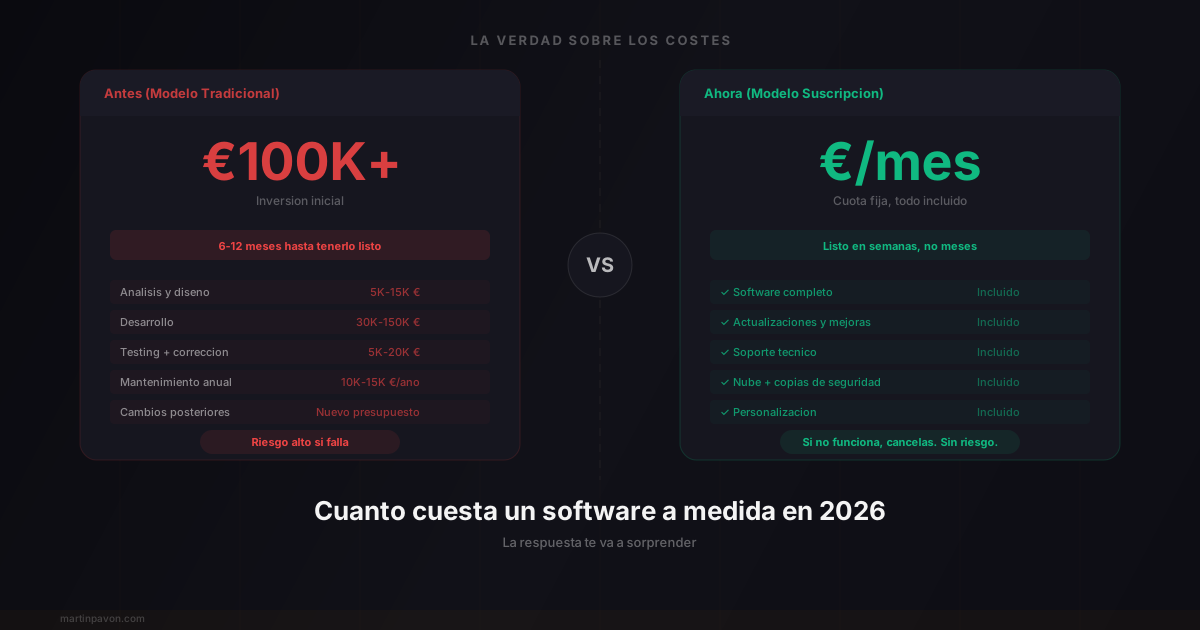

Custom software is a system built specifically for your business workflows — and in 2026 it is no longer out of reach for most SMBs. What used to cost USD 50,000 or more and take 12 months to deliver is now available as a monthly subscription.
The question everyone asks (and nobody answers well)
"How much does it cost to have a system built for my business?"
It's the first question every business owner asks. And for many years, the answer was discouraging: a lot of money, a lot of time, and a lot of risk.
But we're in 2026. And the rules have changed.
What used to cost 50,000 euros and 12 months of waiting can now be up and running in weeks for a monthly fee any SMB can afford.
This guide explains what has changed, why, and how you can have a system built for your business without mortgaging the company.
How it was: the traditional model
Imagine this. It's 2015. You have a yacht charter company and want a system to manage your reservations, boats, crew, and clients. You go to a software consulting firm and they tell you:
The traditional budget
- Requirements analysis: 2-4 weeks, 5,000-15,000 euros
- Design and development: 4-8 months, 30,000-150,000 euros
- Testing and bug fixing: 1-2 months, 5,000-20,000 euros
- Deployment: 2-4 weeks, 3,000-10,000 euros
- Team training: 1 week, 2,000-5,000 euros
The result
- Total cost: 50,000-200,000 euros
- Time until it's ready: 6-12 months
- Team required: 5-10 people
- If you want a change later: another round of budgeting
- If the company closes: you lose the entire investment
And that was if everything went well. Because the reality was that many projects went over budget, took longer than expected, and the end result wasn't exactly what the client had asked for.
With those numbers, it's no surprise that most SMBs never considered having their own software. It was a luxury of large companies.
What has changed (and why everything is different now)
Three things have radically changed the landscape:
The 3 changes that revolutionized costs
- 🛠️
Development tools are better
Ten years ago, building a management system meant writing everything from scratch. Today there are frameworks, libraries, and platforms that allow you to build in weeks what used to take months.
It's like the difference between building a house brick by brick or using high-quality prefabricated modules. The result is the same (or better), but the time and cost are a fraction.
- ☁️
The cloud changed everything
Before, you needed to buy servers, hire someone to maintain them, and pray they wouldn't fail on a Friday night. Today, everything runs in the cloud: your software is available from anywhere, always updated, with automatic backups.
That eliminates thousands of euros in infrastructure that used to be mandatory.
- 💡
The business model has changed
And this is the most important change. The model is no longer "I'll charge you 100,000 euros to build something and then we'll never talk again." The model now is: I'll charge you a monthly fee and you have access to a complete system, always updated, with support included.
It's the difference between buying a 50,000-euro car and paying a 400-euro-per-month lease with maintenance included. Same car. Much more accessible.
The subscription model: how it works
The idea is simple. Instead of paying a fortune upfront for software that could be obsolete in 2 years, you pay a monthly fee that includes everything:
What a typical subscription includes:
- The complete software — all the functions your business needs
- Continuous updates — new features and improvements at no extra cost
- Technical support — someone on the other end when you need help
- Cloud hosting — no servers, no maintenance, access from anywhere
- Backups — your data always protected
- Customization — adapted to how you work, not the other way around
Traditional development
- Initial investment: 50,000-200,000 euros
- Time until you can use it: 6-12 months
- Updates: pay separately each time
- If it doesn't work: you lose your investment
- Maintenance: your problem
- Scaling: another project, another budget
Subscription model
- Initial investment: minimal or none
- Time until you can use it: days or weeks
- Updates: always included
- If it doesn't work: you cancel and move on
- Maintenance: included
- Scaling: activate more features
It's like going from buying a 5,000-euro encyclopedia to having access to all the world's information for 10 euros a month. The value is greater and the risk is lower.
The real numbers: how much you save
Let's do the math with a concrete example. A yacht charter company that needs to manage reservations, boats, crew, documents, and guest experience:
| Concept | Traditional model | Subscription model |
|---|---|---|
| Initial cost | 80,000-150,000 euros | 0 euros |
| Monthly fee | 0 euros (but maintenance payments) | Fixed monthly fee |
| Time until ready | 6-9 months | 2-4 weeks |
| Updates per year | 5,000-15,000 euros extra | Included |
| Technical support | 200-500 euros/hour | Included |
| If I want to change something | New budget | Handled within the service |
| Risk | High (if it fails, I lose my investment) | Low (if it doesn't work, I cancel) |
- 0€Initial investment
- With subscription model
- WeeksDeployment time
- Not months or years
- IncludedSupport and updates
- No surprise costs
Real example: TheCharterPanel
When we started working with yacht charter companies, we saw this problem exactly. Mid-sized companies with 5-15 boats that needed a management system, but couldn't afford a 100,000-euro project.
The solution was TheCharterPanel: a complete charter management system by subscription.
What each charter company gets:
- Reservation management — the full cycle, from inquiry to final payment
- Fleet management — each boat, its availability, its crew
- Guest portal — the traveler sees their itinerary, does digital check-in, requests services
- Crew management — availability, documents, assignments
- Complete dashboard — business metrics in real time
- Constant updates — new features every month at no extra cost
All this for a monthly fee. No initial 100,000-euro investment. No waiting 12 months. No depending on a consulting firm that charges you for every change.
Today, more than 25 charter companies manage their complete operations with TheCharterPanel. Companies that 5 years ago couldn't have afforded their own software.
The same model works in other sectors. GestorSalon does the same for event venues: a complete management system by subscription, with online quotes, menu management, RSVPs, contracts, and payments. No brutal initial investment.
What You Get for Your Money: The Real Numbers
To make this concrete, here is what typical projects look like in 2026:
- A yacht charter management platform: 25 companies currently subscribe to TheCharterPanel, managing 5,000 bookings on a single monthly fee
- Development time with modern tools: what took 12 months in 2015 takes 6 to 8 weeks today
- Typical SMB SaaS stack without custom software: 4 to 6 tools that do not talk to each other
- Monthly subscription cost vs old model: the equivalent of 3 to 5x less than the annual maintenance cost of traditional software
- After the first 3 months, most clients report the system has paid for itself in recovered hours and eliminated errors
These are not projections — they are the real numbers from businesses using subscription-based custom software today.
So, when does each option make sense?
Quick decision guide
- 📋
Your business is standard and small
Use generic tools (CRM, online invoicing, etc.). You don't need anything custom. Our article on how to choose business management software helps you decide which one.
- 🎯
Your sector has specific needs
Look for specialized subscription software. If one exists for your sector (charter, events, clinics, workshops...), that's your best option. You get a system built for you without the cost of developing from scratch. Read more about why specialized software beats generic.
- 🔧
You need something that doesn't exist on the market
Consider custom development with a subscription model. Instead of the classic 100,000-euro project, find a partner that develops for you and converts it into a monthly service. This reduces risk and maintains your cash flow. If you're unsure whether you really need custom software, check out the 5 signs that tell you.
The 5 Cost Factors You Must Clarify Before Signing Anything
Whether you choose traditional development or the subscription model, these 5 questions determine your true total cost:
- What is included in the monthly fee? — Software use, support, updates, hosting, and customization should all be listed explicitly.
- What does data migration cost? — Moving from Excel or an old system can take days or weeks; confirm whether this is included.
- What does team training cost? — The tool is useless if no one uses it properly. Training should be part of the plan.
- What happens if you want a new feature? — In the subscription model this should be included or clearly priced; in traditional development, every change is a new budget.
- What is the exit clause? — What happens to your data if you stop the service? You should always own your own data.
70% of traditional software projects exceed their original budget — according to industry studies — and 60% are delayed beyond their scheduled delivery date. The subscription model eliminates both risks.
The costs nobody tells you about (in any model)
Regardless of which path you choose, there are costs that many providers don't mention. Keep these in mind:
Hidden costs to always ask about:
- Data migration — Moving your information from the old system (or from Excel) to the new one. Can take from hours to weeks, depending on volume and data quality.
- Team training — Your team needs to learn to use the new tool. If the provider doesn't include training, budget for it yourself.
- Customization — Adapting the software to how you work. In the subscription model it's usually included; in the traditional one, each change is a new budget.
- Integrations — Connecting the new system with other tools you already use (email, accounting, etc.).
- Adaptation time — The first 2-4 weeks will be slower. It's normal. It's an investment in future efficiency.
The conclusion is simple
Custom software is no longer a luxury for large companies. Thanks to the subscription model, any SMB can have a system built for their business:
- NoBrutal investment
- Affordable monthly fee, no surprises
- WithEverything included
- Updates, support, improvements
- LessRisk
- If it doesn't work, you cancel. You don't lose 100K.
The question is no longer "Can I afford custom software?" The question is: how much is it costing you NOT to have it? Every manual hour, every lost customer due to lack of follow-up, every piece of data lost between Excel and WhatsApp — that's the real cost.
Want to know how much it would cost to have a system built for your business?