
A CRM doesn't know what a boat is
It seems obvious when you say it that way. But it's exactly the problem thousands of companies face every day: they use tools designed for "any business" to manage a business that isn't "any business."
A generic CRM has no concept of "high season," "crew," "itinerary" or "guest check-in." A project manager doesn't understand that an event has a menu, guests, vendors, setup and teardown. An appointment scheduler doesn't know that a dental treatment has phases, X-rays and consent forms.
Yet millions of businesses still try to squeeze their reality into free text fields and invented categories.
Generic software solves generic problems. Your business isn't generic. Your industry isn't generic. Your way of working isn't generic.
There's an alternative that's growing faster than any other software category. It's called vertical SaaS.
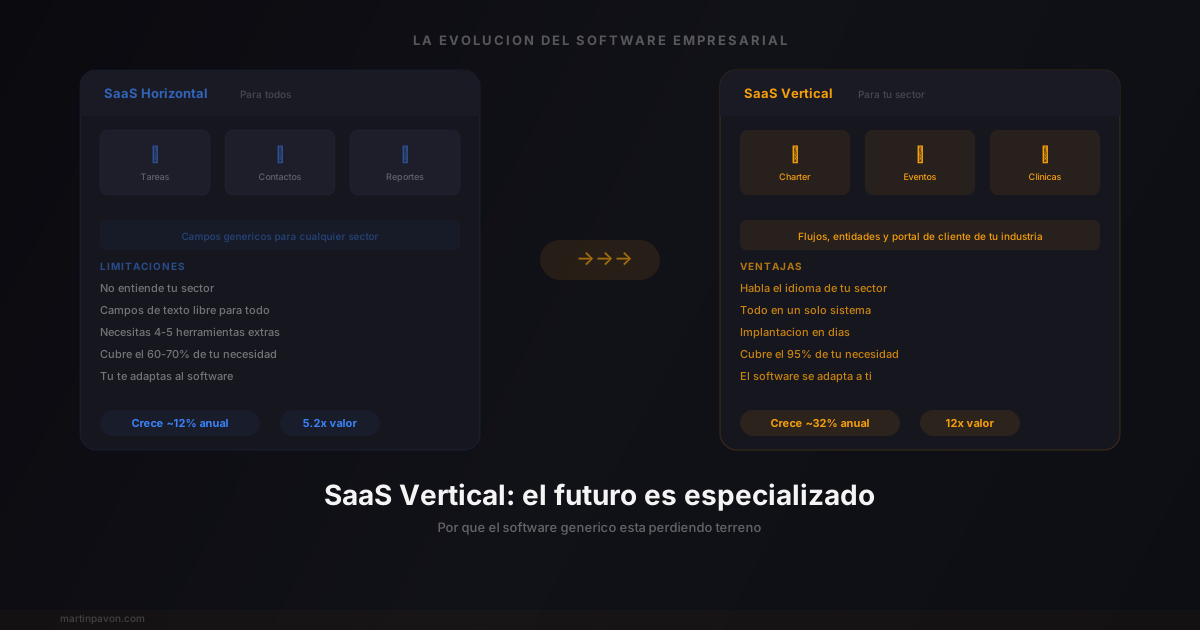
Vertical vs horizontal software: the real difference
Generic Software
One function for all industries
- CRM: manages contacts in any sector
- Project management: generic tasks
- Accounting: standard invoices
- Email marketing: generic campaigns
Examples: HubSpot, Monday, Trello, Mailchimp
The problem: Solves 60-70% of your need. You cover the rest with Excel, WhatsApp and post-its.
Specialized Software
All functions of one industry
- Charter: bookings + crew + itineraries + guest portal
- Events: budgets + menus + RSVP + contracts + payments
- Fitness: classes + memberships + progress + billing
- Clinics: appointments + history + treatments + follow-up
Examples: TheCharterPanel, GestorSalon, Toast, Procore
The advantage: Solves 95% of your need because it was designed for your sector.
The key difference: generic software gives you tools that you adapt to your business. Specialized software gives you a system that already speaks your industry's language.
4 reasons why vertical is winning
Why specialized software dominates
- 🗣️
Speaks your language from day one
You don't need to explain to the software what a "charter booking" or "event with 200 guests" is. The entities, fields, workflows and statuses already exist. That means implementation in days, not months.
When we built TheCharterPanel, charter companies didn't have to "configure" anything. The system already knew what a boat, crew, itinerary and guest are. That changes everything.
- 🧹
Fewer tools, less chaos
With generic software, a typical charter company used: a CRM for customers, an Excel for boats, WhatsApp for crew, Google Drive for documents and email for everything else. That's 5 tools that don't talk to each other.
One specialized platform replaces all 5 with a single platform where everything's connected. A change in the booking automatically updates the crew, itinerary and guest portal.
- 💰
Acquisition cost 8 times lower
Specialized software companies spend up to 22% less on advertising and sales. Why? Because when your product is exactly what an industry needs, word-of-mouth within the sector does the work. One captain recommends to another. One venue owner tells another.
That also means more affordable pricing for you: if the company spends less on marketing, they can charge less for the product.
- 🔒
Brutal retention
Once a business adopts specialized software, it almost never leaves. Why? Because the software becomes part of your daily life. It's not "another tool" — it's THE system where your business lives.
The numbers confirm it: specialized software companies are worth more than double those of generic software with the same revenue. Because their customers stay, pay, and recommend.
The numbers speak for themselves
- 2-3xGrows faster
- Specialized grows twice as fast as generic
- 60%SMBs already use it
- Choose software made for their sector
- x2Worth double
- Specialized software companies are worth more
Specialized software by sector is growing 2 to 3 times faster than generic. This isn't a fad — it's a trend already changing how millions of businesses work.
Real case: TheCharterPanel
When we started working with nautical charter companies, the reality was this:
How they operated before:
- Bookings in an Excel shared by email
- Crew communication via WhatsApp (with photos of documents that get lost)
- Guest check-in with paper forms
- Itineraries that the captain texted to guests
- Invoices manually generated "when we had time"
- Zero visibility for the guest about their own trip
No generic CRM was going to solve this. Because the problem wasn't "managing contacts" — it was managing charters. Boats, seasons, crews, guests, itineraries, extras, digital check-ins.
TheCharterPanel was born as specialized software for nautical charter. Today it manages over 25 charter companies, 5,000+ bookings and 180+ boats. All in a system that speaks the industry's language.
- 25+Charter companies
- Actively using TheCharterPanel
- 5.000+Bookings managed
- Since platform creation
- 180+Boats in system
- Fleets from Mediterranean and Caribbean
The same pattern repeats in other sectors. GestorSalon was born because event venues needed to manage budgets, menus, RSVPs, contracts and payments — not "tasks" and "projects."
Vertical SaaS vs Generic Software: The Data-Driven Comparison
| Metric | Generic (Horizontal) SaaS | Vertical (Industry-Specific) SaaS |
|---|---|---|
| Process fit | 60–70% out of the box | 90–95% out of the box |
| Implementation time | Weeks to months of configuration | Days to weeks |
| Tools needed | 4–6 to cover one workflow | 1 integrated platform |
| Customer retention (NRR) | 100–110% | 120–140% |
| Revenue multiple (valuation) | 5–8x ARR | 10–15x ARR |
| Word-of-mouth acquisition | Low (cross-industry noise) | High (tight industry networks) |
According to Bessemer Venture Partners' State of the Cloud report, vertical SaaS companies grow 2–3x faster than horizontal peers and command significantly higher retention and valuation multiples.
4 Questions to Know if Vertical SaaS is Right for You
Run through these before your next software evaluation:
- Does your business have entities, workflows, or terminology that no generic tool understands out of the box?
- Are you currently using 3 or more tools to cover what one integrated industry platform should handle?
- Does your team waste significant time "translating" your reality into generic categories and workarounds?
- Do your customers expect an experience specific to your industry (portals, documents, statuses)?
60% of SMBs that have switched to vertical software report it replaced 3 or more generic tools — simplifying their stack and reducing total software cost simultaneously.
Vertical SaaS by the Numbers
The performance gap between vertical and generic software is documented:
- Vertical SaaS companies grow 2 to 3x faster than horizontal peers with the same customer acquisition spend
- TheCharterPanel manages 5,000 bookings across 25 companies — what previously required 5 tools now runs on one
- Implementation time for vertical software: 2 to 3 weeks vs 3 to 6 months of configuration for a generic tool
- Customer churn for vertical SaaS is typically 2x lower than horizontal SaaS — because switching costs are real
- Businesses using GestorSalon save 3 hours per event vs the manual multi-tool approach
When to choose vertical vs generic
Not every business needs specialized software. Here's the quick guide:
Choose generic SaaS if...
- Your operation is relatively standard
- You need to solve ONE function (only sales, only accounting)
- You don't have unique workflows specific to your sector
- Your team is small and complexity is low
- Generic tools cover 80%+ of what you need
Choose specialized software if...
- Your sector has jargon, workflows or entities no generic understands
- You use 3+ tools to cover what one specialized should do
- You need an industry-specific client portal
- Your team wastes time "adapting" tools instead of working
- You want implementation in days, not months of configuration
And if your industry doesn't have specialized software? The answer might be building a custom solution. Many of today's successful verticals were born this way: someone who knew an industry and built the solution that was missing.
Generic software doesn't disappear. But it's losing ground.
We're not saying Salesforce or Monday will die tomorrow. They'll stay useful for companies with standard operations. But the trend is undeniable: the future of business software is specialized.
Businesses no longer want to adapt their operation to a tool. They want tools that adapt to their operation. That's exactly what specialized software offers.
The question is no longer "which CRM do I use?" but "is there a complete system for my sector?" If the answer is yes, generic loses its purpose.
If you're evaluating options for your business, our practical guide to choosing management software helps you decide between CRM, ERP, specialized software and custom development.
Want to know if there's a vertical solution for your sector?